Away end capacity at English grounds runs from around 1,500 seats at Wrexham to about 3,000 at Anfield, and the figure printed on a stadium page is often different from the number your club actually gets sold. This is a guide to what an away allocation is, what the competition rules oblige a home club to offer, and how to check a specific ground before you commit to travel.
Every figure below traces to a source I checked. Where sources disagree, I have shown both.
What an away allocation actually is
An away allocation is the block of tickets a home club makes available to the visiting club for one specific match. Three different numbers get described as "away end capacity" in casual use, and they rarely match.
The first is the physical capacity of the away section: how many seats sit inside the blocks a club uses for segregation. The second is the allocation, which is what the home club offers the visiting club for that fixture under the relevant competition rules. The third is the number put on sale, which is what your own club releases after wheelchair bays, official coach-travel holds, returns and any reduction the two clubs have agreed between themselves.
Elland Road shows the gap cleanly. The Football Ground Guide lists 1,566 visitor seats in the upper tier of the John Charles Stand, with a further 1,104 in the lower tier if required, giving a maximum of 2,670. A Leeds away day can be a 1,566-ticket sale or a 2,670-ticket sale depending on the fixture, and both numbers describe the same ground accurately.
The Premier League and EFL rules on minimum away allocations
Both leagues set a floor, and the floor is lower than most fans assume.
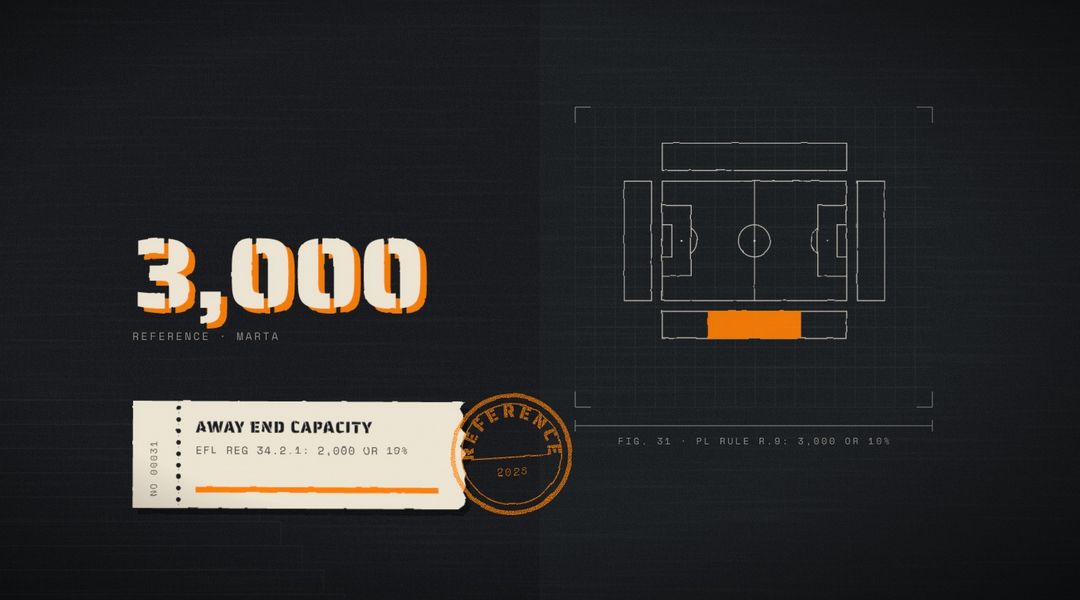
Premier League Handbook Rule R.9 requires the home club to make 3,000 tickets available to the visiting club at each league match, or, if the home stadium's capacity is below 30,000, a number equal to 10% of that capacity. The rule also requires that the allocation includes a minimum of 10% of the home club's disabled spectator accommodation.
EFL Regulation 34.2.1 is worded differently and lands lower: "Each Club must make provision for at least 2,000 visiting supporters at every home match or such number as represents 10% of the Club's certified capacity, if less than 2,000." So an EFL ground holding 12,000 owes visitors 1,200. That clause explains most of the small away ends in League One and League Two.
Two things worth holding on to. The floor is a minimum, so a club offering more is still complying, and plenty do. And the entitlement sits between the clubs: if your club hands tickets back, that is its commercial decision, and the home club has broken nothing.
Away end capacity at well-known English grounds
Here are the figures I could verify, with total capacity shown from two sources where they differ.
| Ground | Club | Total capacity | Away section | Typical league away allocation |
|---|---|---|---|---|
| Molineux | Wolves | 31,750 (ONTOUR) / 31,700 (FGG) | Steve Bull Stand, lower tier | around 2,750, with a further 1,500 available if required |
| Cardiff City Stadium | Cardiff City | 33,280 | Corner between the Grange and Ninian stands, blocks 119-123 | up to 1,800 |
| Racecourse Ground / STōK Cae Ras | Wrexham | 10,771 (ONTOUR) / 12,600 (FGG) | Wrexham Lager Stand, upper tier, gates 1-4 | around 1,500 |
| Anfield | Liverpool | 61,276 | Anfield Road stand | around 3,000 |
| Old Trafford | Manchester United | 74,244 (ONTOUR) / 74,879 (FGG) | Corner of the Sir Bobby Charlton Stand and the East Stand | around 3,000 |
| Villa Park | Aston Villa | 43,205 (ONTOUR) / 42,785 (FGG) | Doug Ellis Stand, blocks P and Q across both tiers | around 2,900 (1,600 lower, 1,300 upper) |
| St James' Park | Newcastle United | 52,405 | Leazes Stand, upper tier | up to 3,000 |
| Elland Road | Leeds United | 37,645 (ONTOUR) / 37,792 (FGG) | John Charles Stand, towards the South Stand | 1,566, extendable to 2,670 |
Allocations and section locations come from the Football Ground Guide page for each ground, except Wrexham's 1,500, which comes from the Away Games guide. Capacities marked ONTOUR come from the public venue records behind ontourfootball.com/stadiums; the rest are Football Ground Guide figures.
Treat the Wrexham row with most care. ONTOUR and Away Games both hold 10,771, the Football Ground Guide lists 12,600, and the Kop redevelopment is under construction, with the finished ground expected to pass 18,000. Any Wrexham figure quoted today has a short shelf life, and the away allocation will move with it.
Why the quoted figure and the tickets on sale differ
The quoted figure describes what the ground can do; the tickets on sale describe what two clubs settled on for one match. Four things move the number.
Clubs agree reductions. In January 2024 Liverpool allocated Burnley 1,900 seats at Anfield for a league fixture, well under the 3,000 in Rule R.9, a case supporters documented by working through the handbook wording themselves. Reductions happen by agreement or board approval and stay invisible from outside until the sale opens.
Demand shapes it in the other direction. Molineux holds about 2,750 visitors as standard and can open a further 1,500 in the Steve Bull Stand when the travelling support justifies it. Elland Road's lower tier works the same way.
Safety overrides both. A Safety Advisory Group, made up of local authority, police, transport and club representatives, issues and conditions the ground's safety certificate. If it caps a section, that cap holds whatever the competition rules entitle the visiting club to.
And your own club hands tickets back. Long trip, midweek kickoff, a tie nobody fancies: unsold seats are returned and the block shrinks.
How cup ties change the allocation
Cup ties usually increase the away allocation, sometimes sharply. FA Cup rules give the visiting club the right to claim up to 15% of all accommodation for which tickets are issued, a much larger share than either league minimum. At a 60,000-seat ground that is roughly 9,000 seats.
That entitlement is still subject to the local Safety Advisory Group agreeing to it. In practice SAGs regularly cut the figure, and clubs have had allocations reduced on stated safety grounds while supporters argued the reasoning did not hold. Treat the 15% as a ceiling you can claim and plan your travel on the figure your club confirms.
Cup allocations also arrive later and on shorter notice, because replay and broadcast scheduling has to settle first. If you are chasing grounds for the 92 Club or working through a groundhopping list, cup rounds are the cheapest way into a big away end and the worst fixtures to book non-refundable travel for.
Segregation and restricted view in the away end
Away sections are placed for segregation first and sightlines second, which is why so many sit in a corner or along one side of a stand rather than behind a goal.
Cardiff City Stadium puts visitors in the corner between the Grange and Ninian stands, with a fenced compound that also holds the away coaches so departing fans stay separated after full time. Villa Park splits its allocation vertically across two tiers of the Doug Ellis Stand, so a group buying together can end up in blocks P and Q with a floor between them.
Restricted view is a separate question, and it is normally disclosed at the point of sale. At Molineux, away fans in the Steve Bull lower sit a long way back from the pitch with home supporters in the tier directly above. Roof supports and camera gantries produce seats that are legitimately sold and genuinely part-obstructed. If a ticket is priced below the rest of its block, that is usually the reason.
How to check a specific ground before you travel
Check four things, in this order.
- Your own club's ticket page for that fixture. This is the only number that binds. It tells you what was actually received and what is on sale, and it supersedes every stadium guide.
- The home club's supporter information page. Clubs publish the away blocks, turnstiles, coach drop-off and segregation arrangements here, along with restricted-view flags and accessible seating.
- A ground guide for the layout. The Football Ground Guide and similar sites are good on where the away end physically is and what the view is like. Their allocation figures describe what usually happens, so check them against the live sale.
- The fixture itself. Competition, date and kickoff time move everything: a midweek cup tie and a Saturday league game at the same ground can be different away ends.
ONTOUR's stadium pages carry each ground's total capacity, location and upcoming fixtures, and the app shows how many fans have marked themselves as going. It does not carry a per-fixture away allocation, so step 1 above is still the number that binds. What it adds is the part a ticket page has no reason to tell you, which is who else is travelling and which grounds you have already ticked off across a season of away days. On the name, since it catches people out: ONTOUR here is the football app, unrelated to the logistics, travel and clothing firms using similar names, and it means being on tour with your club.
Away end figures date fast. Wrexham's changes when the new Kop opens, and any club can renegotiate an allocation for a single fixture. Use the table as a planning baseline and your club's ticket page as the final word.
Away allocations and stand locations from the Football Ground Guide and Away Games. Competition minimums from the Premier League Handbook, EFL Regulation 34.2.1 and the FA Cup rules. Capacities marked ONTOUR from the public venues API on 22 September 2026. Written with AI assistance and edited by a human before publication.
