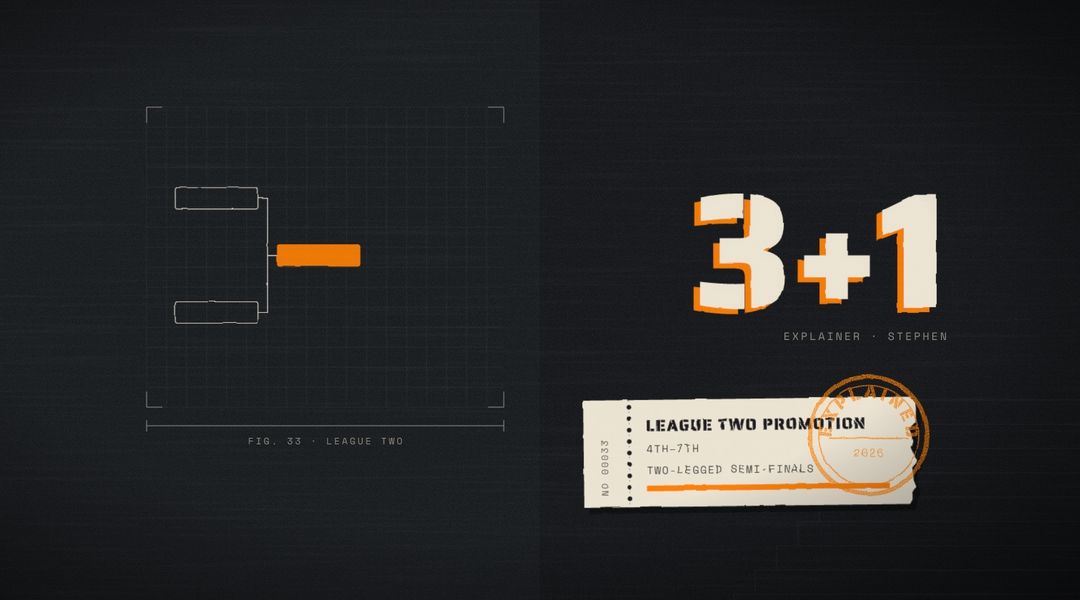
League Two promotion runs on a three-plus-one structure. Three clubs go up automatically each May, and a fourth earns the final League One place through the play-offs. Relegation works the other way, sending the bottom two down into the National League, which then sends two clubs back up through a promotion system that looks similar on paper but plays out differently in practice. The two competitions share a shape but not a format, and the gap between them is worth understanding properly, because the National League does not simply copy the EFL.
How many teams are promoted automatically from League Two?
Three clubs finish the job without needing a play-off. The top three in the League Two table at the end of the season go straight up to League One, full stop, no extra fixtures required. In 2025-26 that meant Bromley, Milton Keynes Dons and Cambridge United, who all secured their places before the rest of the division had finished sorting out who would join them the harder way.
How does the League Two play-off work?
A fourth promotion place goes to whichever club survives a four-team knockout drawn from the sides that finished fourth to seventh. The semi-finals pair fourth against seventh and fifth against sixth, each tie played over two legs with the higher-placed side hosting the second one, a deliberate reward for finishing higher in the table. Away goals do not count double, so a tie level on aggregate after 180 minutes goes to extra time and then penalties if it is still unresolved. The two semi-final winners meet in a single final at Wembley for the last League One place.
The 2025-26 season is the clearest recent example. Salford City, Notts County, Chesterfield and Grimsby Town filled the four play-off spots behind the automatic three, and Notts County beat Salford City 3-0 in the final on 25 May 2026 to complete the promotion picture for League Two.
How many teams go down from League Two?
Two clubs drop out of the Football League altogether. The bottom two in League Two are relegated to the National League each season, a smaller cut than the four that go down from League One, because the tier below only has two promotion places of its own to offer in return. That balance is not an accident. Two down from League Two lines up with two up from the National League, and the numbers across the whole pyramid are built to match at every level.
How do teams get promoted from the National League into League Two?
Two places are available, split the same way as every other promotion route in English football: the National League champions go up automatically, and a second club earns the final spot through a play-off. York City took the automatic route as 2025-26 National League champions, returning to League Two a decade after they were last relegated from it. Rochdale took the harder path, beating Boreham Wood on penalties in the play-off final at Wembley on 10 May 2026 after a 2-2 draw. Both stories, and what their return means for groundhoppers tracking the 92 Club, are covered in more depth in ONTOUR's piece on how the 92 Club's list of valid grounds shifts every season.
Why does the National League play-off format look different from League Two's?
It uses six teams rather than four, and every match in it is a single leg. Second and third place get byes straight into the semi-finals, while fourth to seventh play off against each other first to decide who joins them. Second faces the winner of fifth versus sixth, and third faces the winner of fourth versus seventh, with the higher-placed side hosting throughout. Extra time and penalties settle anything still level after 90 minutes, and because every round is a single match that applies to the semi-finals too, where League Two plays two legs. The National League final is still a single match at Wembley, so the two competitions converge at the very end even though they reach it by different routes.
That distinction matters if you are trying to predict how a promotion push will play out. A club chasing an automatic League Two place is managing a two-legged tie with an away-goals-free aggregate score to think about. A club chasing the National League's second spot is managing a run of knockout matches where one bad afternoon, home advantage or not, ends the season.
Has the format always worked this way?
No, both competitions have changed shape over time, and the gap between them is the product of separate decisions taken decades apart, with no single body designing both at once. The EFL's play-offs date back to 1987, and League Two's version did not settle into today's fourth-to-seventh format straight away. In the first two seasons, the four-team field was made up of the three clubs finishing directly below the automatic promotion places plus the club that finished just above the automatic relegation zone in the division above, a cross-division wrinkle that lasted only two years before the EFL simplified it from 1988-89 onwards to the shape still used now, four clubs drawn purely from within the division itself. The final was played over two legs for its first three stagings before switching to a single match from 1989-90, hosted at Wembley or, while the stadium was being rebuilt in the 2000s, at the Millennium Stadium in Cardiff.
The National League's six-team version is much younger. Before 2017-18, its play-offs ran on the same four-team model League Two still uses today, second to fifth in a straight knockout. The expansion to six teams, with byes for second and third and a qualifying round for fourth to seventh, arrived for the 2017-18 season and has stayed in place since, which is why the two competitions now look structurally different even though they sit one tier apart and both still end at Wembley. The shape is still moving above them: the Championship expands its play-offs from four teams to six from 2026-27. That change applies to the Championship only, so League Two's four-team format stands.
Where do National League North and South fit into this?
They sit directly below the National League and exist to keep the whole structure balanced. National League North and National League South are Step 2 of the non-league pyramid, each running with 24 clubs. Two teams come up from each of them every season, the divisional champions automatically and a second club through a play-off among the second-to-seventh-placed sides, mirroring the format used one level up. That gives four promoted clubs in total, two from the North and two from the South, which is exactly the number needed to replace the four teams relegated from the National League each year and keep every division at a stable size.
It is a tidy piece of design once you see the whole ladder laid out. Every relegation total at one level is matched by a promotion total at the level below, all the way from League Two down through the National League and into its regional feeders. Following that chain across a full season, not only the Premier League end of the pyramid, is where ONTOUR's coverage is built to sit: League Two and National League results and tables live alongside the top divisions, so a promotion race that crosses the Football League boundary reads as one fixtures list instead of two sites stitched together.
Written with AI assistance and edited by a human before publication.
